Everything here is written from scientific sources. If you have any doubts, check the original sources.
Your baby this week
Ovulation happens about 14 days after your last period, and fertilisation usually takes place around this time1.
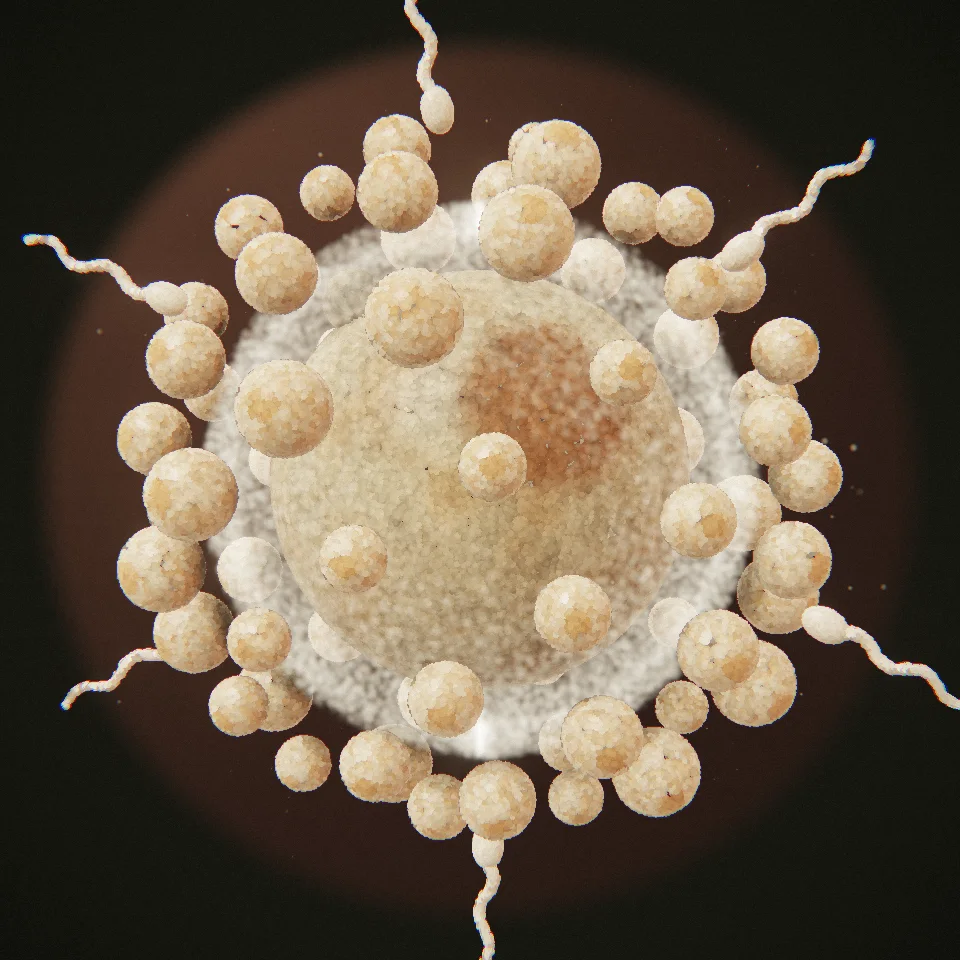
The egg leaves the ovary and enters the funnel-shaped end of one of the fallopian tubes. At ovulation, the mucus in the cervix becomes thinner and more elastic, which lets sperm get in quickly. Within 5 minutes they can reach the fallopian tube, which is where fertilisation usually happens1.
If a sperm gets into the egg, fertilisation takes place. The fertilised egg, called a zygote, starts dividing again and again while cells with tiny hair-like structures sweep it along the tube towards the uterus1.
This is also where twins begin. Identical twins come from one fertilised egg that splits into two embryos. If two eggs are released and fertilised, the twins are not identical1.
Your body
Ovulation happens in the middle of the cycle, around day 14. Once released, the egg lives for only about 24 hours. If it is not fertilised in that time, it leaves the body with your period2.
Sperm can live for about 3 or 4 days inside the female reproductive tract. So if they arrive before ovulation, they can wait for the egg. The fertile days are the three days before ovulation, the day itself and the day after: roughly days 11 to 15 of the cycle2.
Not everyone has regular cycles, and then it can be hard to notice that a period is late3.
If you’re having IVF
In an IVF cycle, the days that match this stage are spent stimulating the ovaries and checking how they respond with blood tests or scans4. The aim is for the ovaries to produce several eggs in a single cycle4.
The NHS describes about 2 weeks of daily injections5. In some protocols, this is preceded by 2 to 3 weeks of injections or a nasal spray to stop the ovaries producing eggs naturally5; in others, that stage is skipped4.
Egg collection takes about half an hour and is done under sedation or general anaesthetic4. A doctor collects the eggs with a needle passed through the vagina5. Afterwards you may feel a little sore or bruised4.
The eggs are fertilised in the laboratory, and the clinic usually calls the next day to tell you how many embryos have formed5. A full cycle takes 3 to 6 weeks4.
Health and tips
Folic acid. Folate needs to be there in the first weeks after conception, often before you know you are pregnant6. If you are trying to get pregnant, ideally you will have started it at least a month before, at 0.4 to 0.8 mg a day7.
Smoking, alcohol and caffeine. For early pregnancy, the NHS advises stopping smoking and drinking alcohol, and going easy on tea, coffee and drinks with caffeine8.
Medicines. In the weeks when the organs are forming, the embryo is more vulnerable to medicines, drugs and viral infections. During pregnancy, only take medicines that are essential and known to be safe1.
Stress. Fertility treatment can be stressful, but there is no conclusive evidence that stress changes the outcome4. That does not mean it does not matter: IVF takes a high emotional toll, and getting support is important4.
Moving. The recommendation is 150 minutes of exercise a week. You can start with a 10-minute brisk walk each day and listen to your body8.
For your partner or supporter
If you are the partner or the person supporting her through IVF, you have a role too. The partner usually gives a sperm sample while the eggs are being collected, or donor sperm is made ready5.
Counselling is recommended for anyone having IVF, and your clinic should offer it before, during and after treatment5.
There is also advice for any pregnancy: eat healthily together and, if you smoke, get help to stop. It is normal for both of you to have mixed feelings, even if the pregnancy was very much wanted9.
When to get help
If you are having IVF, there is a small chance that the ovaries overreact to the medicine. They then become large and painful5. Call your clinic as soon as possible if you have pain and bloating in your tummy, feel or are sick, feel faint, have vaginal bleeding, or have pain when you pee or poo5.
Go to the emergency department if you have difficulty breathing, pain in your chest or upper back, are very thirsty and peeing less, have swelling in any part of your body, have tummy pain low down on one side, or pain in the tip of your shoulder5.
Frequently asked questions
When does ovulation happen?
About 14 days after your last period.
Which are the fertile days?
The three days before ovulation, the day of ovulation and the day after, which in a regular cycle are usually days 11 to 15.
Sources
- MSD Manual, versió per al públic. Stages of Development of the Fetus. msdmanuals.com.
- Hospital Clínic de Barcelona. Pregnancy and Childbirth. clinicbarcelona.org.
- National Health Service (NHS), Regne Unit. 5 weeks pregnant guide. NHS Best Start in Life.
- Human Fertilisation and Embryology Authority (HFEA). In vitro fertilisation (IVF). hfea.gov.uk.
- National Health Service (NHS), Regne Unit. IVF. nhs.uk.
- Harvard T.H. Chan School of Public Health. Folate (Folic Acid): Vitamin B9. The Nutrition Source.
- US Preventive Services Task Force. Folic Acid Supplementation to Prevent Neural Tube Defects: Preventive Medication. Recomanació, 1 d’agost de 2023.
- National Health Service (NHS), Regne Unit. 4 weeks pregnant guide. NHS Best Start in Life.
- NHS 111 Wales. Dads and partners. 111.wales.nhs.uk.