Everything here is written from scientific sources. If you have any doubts, check the original sources.
Your baby this week
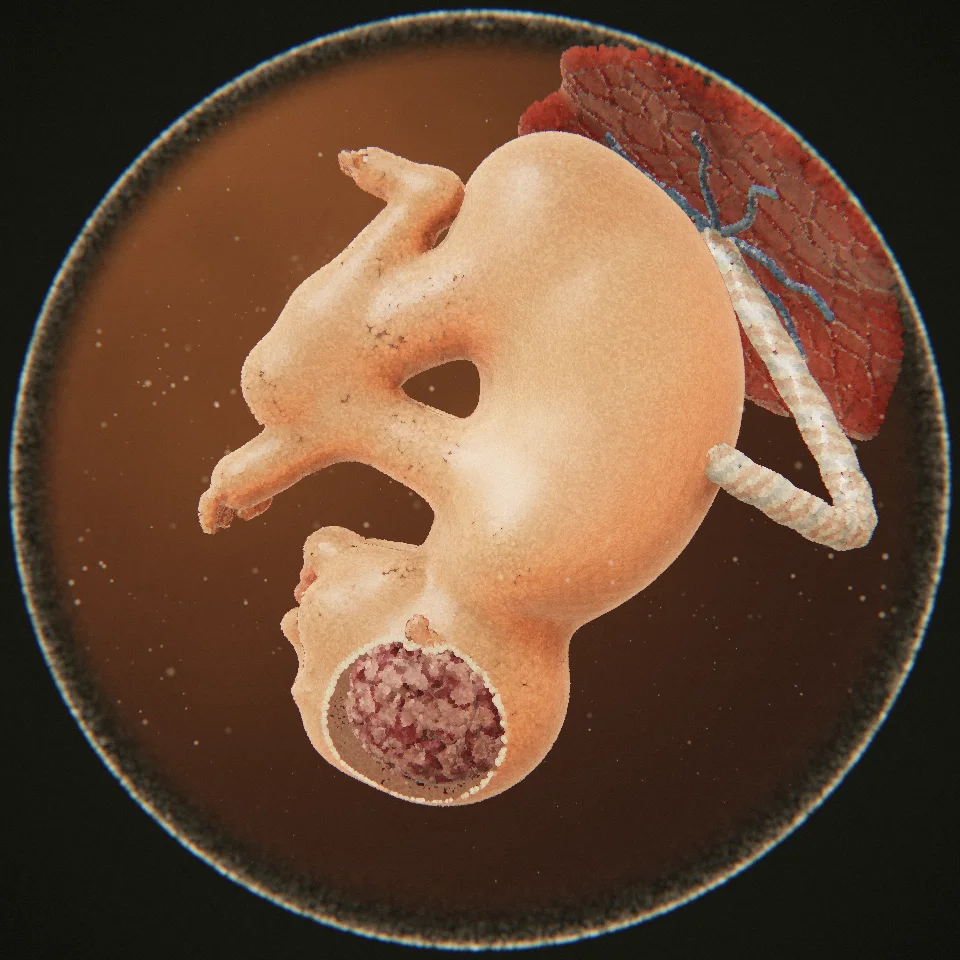
Your baby is about 50.7 cm from head to heel, roughly the size of a watermelon1. The WHO median estimated fetal weight for this week is 3,403 g2.
A few weeks ago their skin was almost transparent. Now a tougher new layer is growing, which better protects their internal organs and helps with temperature control1.
Their skin is coated in vernix, a white, waxy substance. This creamy layer protects the skin and helps your baby move down the birth canal. Your baby might be covered in it at birth, or it could be mostly gone1.
ACOG defines full term as 39+0 to 40+6 weeks3. Pregnancy normally lasts around 40 weeks, and most labours start within a week either side of the due date1.
Your body
You might be getting a lot more discharge than usual. It should be thin and white and not smell much1.
If you spot a slimy blob of yellow or bloody mucus, that is called a “show”. It used to plug your cervix, and when it comes out it can be one of the first signs that labour is on its way. Even so, you could still have days to wait1.
As your baby moves down your pelvis and presses on your spine, you may get back pain and feel more pressure at the bottom of your bump. You might also get sudden bursts of energy and want to fold baby clothes or tidy drawers. That is your nesting instinct1.
You may be having lots of practice contractions. If they start to become painful, they could be the real thing1.
Health and tips
Watch for your waters. They could break at any time, and you should not expect a gush: it could be just a trickle. If you think it has happened, call your midwife or doctor. If your waters have broken, labour may need to be induced, as your baby will be at greater risk of infection1.
What happens at birth. A few things you might not expect1:
- Babies do not always come out crying. It can take a few seconds before they cry or splutter to clear their airways.
- Within a minute, your baby is rated on the Apgar scale for heart rate, breathing, muscle tone, responsiveness and skin colour. This is repeated at 5 minutes.
- Their hands and feet might be blue, as their circulation is still getting going.
- Their breathing may be irregular, with gaps of up to 5 seconds. This is normal: they are learning to breathe.
- It is not always love at first sight. Give yourself time to bond, and ask for help if you need it.
- It can take 6 weeks for your womb to go back to its usual size. Breastfeeding can speed this up.
Thinking ahead. Now is a good time to decide what contraception you would like to use after the birth. You could get pregnant again sooner than you think, and too short a gap between pregnancies can cause problems1.
Time in nature. A walk in the park or the woods, or a little gardening with gloves on, is good exercise and helps your brain release feel-good chemicals1.
For your partner or supporter
If you are the partner or the person supporting her, seeing the baby born can be an intense experience. The midwife may hand you the baby: do not be afraid of hurting them, and hold them close to your body. Strong emotions are common, and some people cry4.
In the first few weeks, you can help a lot by4:
- Keeping visitors to a reasonable number, as too many can exhaust the mother and baby.
- Looking after the baby so she can get a good rest each day.
- Taking over the basic housework, without worrying about keeping the place spotless.
- Learning to change nappies and bathe the baby.
- Bringing her a snack and a drink while she breastfeeds or, if the baby is bottle fed, making up the bottles and sharing the feeds.
When to get help
The NHS says to treat these signs as an emergency and call your midwife or doctor1:
- Bleeding from your vagina, or brown or pink discharge.
- Severe itching, particularly at night.
- A terrible headache that won’t go away.
- Vision problems.
- Pain just below the ribs.
- Extreme swelling of the feet, ankles, hands and face.
- Persistent stomach pains.
- A temperature above 37.5 °C with no other symptoms.
Call your hospital or midwife when your contractions last at least 60 seconds and come every 5 minutes. Call at any time if you are worried something is wrong, for example if your baby stops moving or you are losing blood1.
Frequently asked questions
How big is the fetus at week 39 of pregnancy?
According to the NHS, it is about 50.7 cm, head to heel. The WHO median estimated weight is 3,403 g.
What is the Apgar score?
An assessment of the baby at 1 and 5 minutes, covering heart rate, breathing, muscle tone, responsiveness and colour.
When should I call if I am having contractions?
When they last at least 60 seconds and come every 5 minutes. Call sooner if you are worried, if you are bleeding or if your baby is moving less.
Sources
- National Health Service (NHS), Regne Unit. 39 weeks pregnant guide. NHS Best Start in Life.
- World Health Organization (Kiserud T, et al.). The World Health Organization Fetal Growth Charts: A Multinational Longitudinal Study of Ultrasound Biometric Measurements and Estimated Fetal Weight. PLoS Med 2017;14(1):e1002220.
- ACOG; Society for Maternal-Fetal Medicine. Committee Opinion No 579: Definition of Term Pregnancy. Obstet Gynecol 2013;122(5):1139-1140.
- NHS 111 Wales. Dads and partners. 111.wales.nhs.uk.
- Hospital Clínic de Barcelona. Pregnancy and Childbirth: alarm signs. clinicbarcelona.org.