Everything here is written from scientific sources. If you have any doubts, check the original sources.
Your baby this week
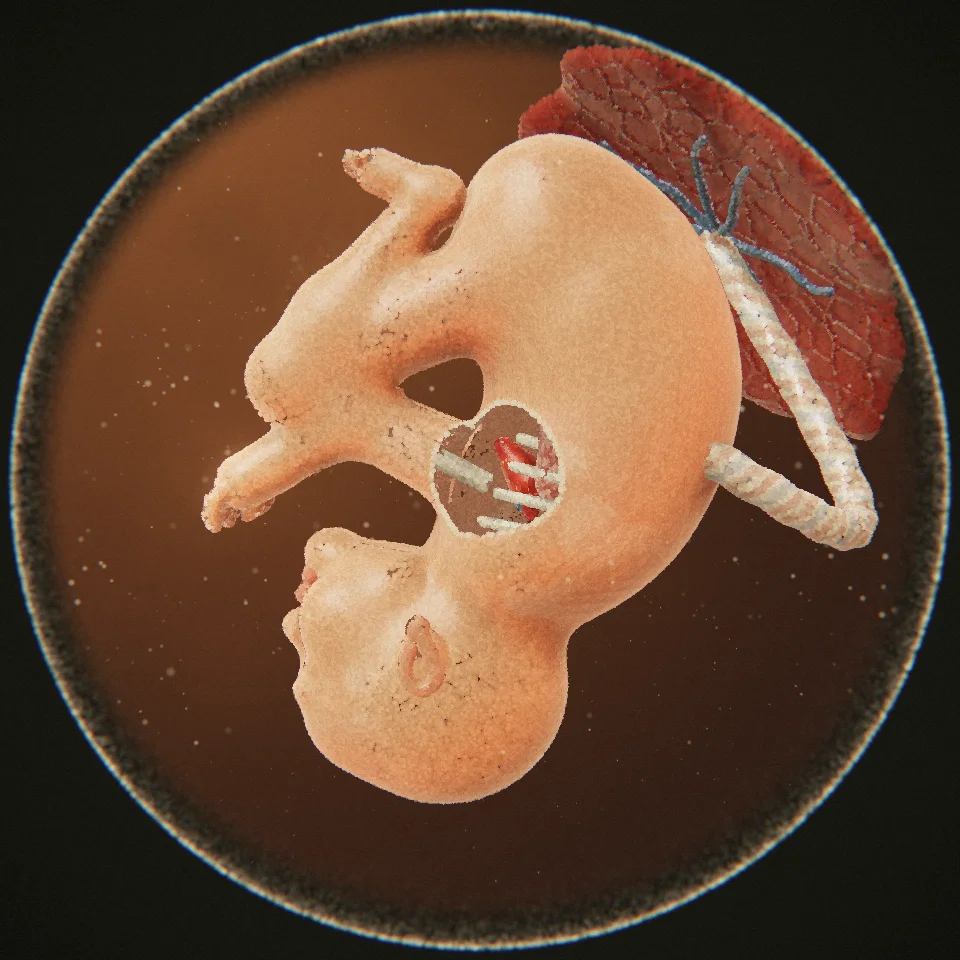
Your baby is about 48.6 cm from head to heel, roughly the length of a leek1. The WHO median estimated fetal weight for this week is 2,966 g2.
They are trying out facial expressions, such as frowning and smiling, but this is random. You probably know by now when they are active and when they are calmer1.
The NHS already considers your baby full term: they are probably big enough and mature enough to survive outside the womb. They could come any day, although you may still have a few weeks to wait1.
ACOG calls weeks 37+0 to 38+6 early term3, while the NHS already says full term1. The BCNatal protocol includes a scan at week 37±1 in low-risk pregnancies4.
Your body
Around 95% of babies are now head-down, facing their mother’s back, the best position for labour. When the head moves down into the pelvis, it is said to be engaged, and you might see your bump drop a little1.
If your baby is still bottom-down (breech), there is still time for them to turn, and some do not move into place until labour starts. When you sit, try leaning forwards with your hips above your knees. It is not a proven technique, but it will not do any harm1.
As your baby moves down, you may get some relief from heartburn and from needing to pee all the time. On the other hand, you may notice more vaginal discharge and more Braxton Hicks contractions, which can feel uncomfortable but should not be painful. Backache, poor sleep and swollen hands and feet are also common1.
You might get a sudden urge to tidy everything. That is your nesting instinct. Do not overdo it, and rest as much as you can1.
How to tell if labour is starting
Signs that labour might be starting include1:
- Contractions or tightenings.
- A sticky blob of yellow or bloody mucus.
- Back pain.
- An urge to go to the toilet from the baby’s head pressing down.
- Your waters breaking.
Health and tips
Group B strep. This is a common bacteria: up to 2 in 5 people have it living in their body. If you carry it while pregnant, there is a small risk it could make your baby seriously ill, but most group B strep infections in newborns are preventable. Talk to your midwife about it1.
The RSV vaccine. If you did not have it at around week 28, you can still have it right up until labour starts. It lowers your baby’s risk of severe bronchiolitis1.
Your pelvic floor. Gentle exercises can help prevent leaks when you laugh, cough or sneeze. Pretend you are having a pee and then stop midflow1.
Postnatal depression. It affects more than 1 in 10 women, usually develops in the first year and can come on gradually. Signs include low mood, losing interest in things, feeling tired all the time, or finding it hard to look after yourself or your baby. It is an illness like any other, and it is not your fault1.
For your partner or supporter
Towards the end of pregnancy, tiredness and irritability often return, and fear of the birth can set in. If you are the partner or the person supporting her, encourage her to talk about her worries, with you, the midwife or family, and be patient5.
Learn about postnatal depression too: it can affect the mother, and partners as well. And, if you would both like to, go to antenatal classes together1.
If you’re expecting twins
If you are expecting twins, you will probably give birth this week: twin pregnancies rarely go beyond 38 weeks1.
Twins with a placenta each are offered a planned birth at 37 weeks, and identical twins sharing a placenta at 36 weeks. Carrying on past these dates can be dangerous. If you turn down a planned birth, you will be offered weekly appointments with an obstetrician, a scan every week and a growth scan every 2 weeks6. Around 6 in 10 twins are born before 37 weeks6.
When to get help
Get medical advice for any bleeding1. Your baby’s movements should not slow down or stop: if you notice any change, call your midwife or maternity unit straight away7.
Get urgent help if you have a severe headache that does not go away with simple painkillers, vision problems, pain below the ribs, or sudden swelling of the face, hands or feet. These can be signs of pre-eclampsia8.
If you feel anxious or low, or think you or your partner might have postnatal depression, talk to your midwife or doctor as soon as possible1.
Frequently asked questions
How big is the fetus at week 37 of pregnancy?
According to the NHS, it is about 48.6 cm, head to heel. The WHO median estimated weight is 2,966 g.
What are the signs labour is starting?
Contractions, a show of mucus, back pain, pressure on the bowel or bladder, and waters breaking.
What is group B strep?
A common bacteria that many people carry without knowing. In pregnancy it carries a small risk for the baby, and most infections can be prevented. Talk to your midwife about it.
Sources
- National Health Service (NHS), Regne Unit. 37 weeks pregnant guide. NHS Best Start in Life.
- World Health Organization (Kiserud T, et al.). The World Health Organization Fetal Growth Charts: A Multinational Longitudinal Study of Ultrasound Biometric Measurements and Estimated Fetal Weight. PLoS Med 2017;14(1):e1002220.
- ACOG; Society for Maternal-Fetal Medicine. Committee Opinion No 579: Definition of Term Pregnancy. Obstet Gynecol 2013;122(5):1139-1140.
- BCNatal: Hospital Clínic, Hospital Sant Joan de Déu, Universitat de Barcelona. Protocolo: screening ecográfico fetal (actualització: 18 d’octubre de 2016). Protocols de Medicina Fetal i Perinatal.
- NHS 111 Wales. Dads and partners. 111.wales.nhs.uk.
- National Health Service (NHS), Regne Unit. Antenatal care with twins. nhs.uk.
- National Health Service (NHS), Regne Unit. 40 weeks pregnant guide. NHS Best Start in Life.
- National Health Service (NHS), Regne Unit. Pre-eclampsia. nhs.uk.
- Hospital Clínic de Barcelona. Pregnancy and Childbirth: alarm signs. clinicbarcelona.org.