Everything here is written from scientific sources. If you have any doubts, check the original sources.
Your baby this week
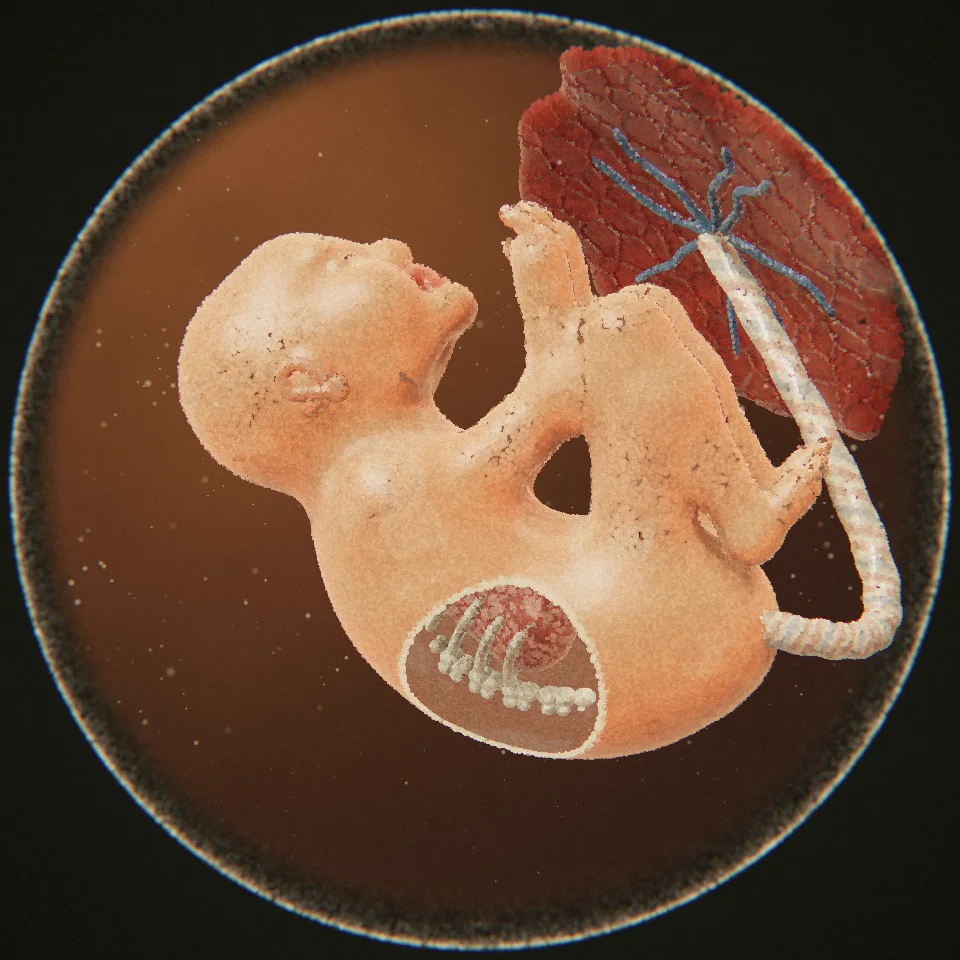
Your baby is about 43.7 cm from head to heel, roughly the size of a pineapple1. The WHO median estimated fetal weight for this week is 2,103 g2.
Their bones are hardening, apart from the skull bones, which stay soft and separated until around 12 to 18 months. This slight flexibility makes the journey down the birth canal a bit easier1.
The NHS describes the brain and nervous system as fully developed1, while ACOG places the end of this process at weeks 37 to 403.
Your body
With about six weeks to go, it’s normal to feel really tired: you’re carrying a few extra kilos1.
Your womb may start preparing for birth with Braxton Hicks contractions, sometimes called practice contractions. They feel like a tightening over your bump for 20 to 30 seconds before the muscles relax again. They shouldn’t hurt1.
You may also feel something weighing down on your pelvis. This can be a sign that your baby is head down, ready for birth1. Other common symptoms at this stage include1:
- Sleeping problems and tiredness.
- Backache and pain on the sides of your bump.
- Heartburn and indigestion.
- Leg cramps.
- Swollen hands and feet.
- Sore breasts, which sometimes leak a little.
Health and tips
Your hospital bag. Only 1 in 20 babies arrive on their due date. It’s a good idea to have your bag ready in case your baby comes early1:
- Birth plan and pregnancy notes.
- Clothes and nappies for the baby.
- Something loose and comfy to wear in labour.
- Spare clothes and nightclothes.
- Nursing bras and breast pads.
- Super absorbent sanitary pads, a wash bag and towels.
- Healthy snacks and any medicines you take.
Contacts for labour. Save in your phone the number for your midwife or hospital, your hospital reference number if you have one, your birth partner’s number and the full address of where you’re going. Plan who will drive you or which taxi you’ll call, as it’s not safe to drive yourself. Write it all down too, in case your phone runs out of battery1.
Group B strep. It’s a common bacteria: up to 2 in 5 people have it in their body. If you carry it while pregnant, there’s a small risk it could make your baby seriously ill, but most group B strep infections in newborns can be prevented. Ask your midwife1.
Car seat. To bring your baby home by car, you’ll need a car seat. Ideally buy a new one, so you know it has never been damaged. Carrying your baby in your arms in the car is far too dangerous. Practise fitting and removing it, as it can be fiddly at first1.
Vitamin D. It helps keep bones and muscles healthy. Between October and early March, when sunlight isn’t enough, the NHS advises a daily 10 microgram supplement1.
For your partner or supporter
In these final weeks, if you’re the partner or the person supporting her, a checklist can help4:
- Make sure you can be contacted at all times.
- Decide how you’ll get to the hospital, if that’s where the birth will be.
- If you’re using your own car, check it works and has fuel, and do a trial run to see how long the journey takes.
- Pack a bag for yourself too, with snacks, a camera and your phone.
It’s normal for both of you to have mixed feelings: such a big change can be frightening, even when it’s very much wanted4.
When to get help
If the contractions become painful or start coming at regular intervals, contact your midwife or hospital in case you’re going into labour1.
From week 24 you should notice your baby moving every day. To check, Hospital Clínic advises lying on your left side after a main meal and counting at least 10 movements in two hours5. If the pattern changes or your baby stops moving, call as soon as possible6.
Very itchy skin, especially on the palms of your hands or soles of your feet, or itching that’s worse at night, can be a sign of intrahepatic cholestasis of pregnancy, a liver condition that needs treatment. Get urgent help7.
Get any bleeding checked1. And if you have a severe headache, blurred vision, pain below your ribs or sudden swelling of your face, hands or feet, contact your maternity unit straight away8.
Frequently asked questions
How big is the fetus at week 33 of pregnancy?
According to the NHS, it is about 43.7 cm, head to heel. The WHO median estimated weight is 2,103 g.
How many babies arrive on their due date?
According to the NHS, only 1 in 20.
Do Braxton Hicks contractions hurt?
They shouldn't. If they become painful or start coming at regular intervals, contact your midwife or hospital.
Sources
- National Health Service (NHS), Regne Unit. 33 weeks pregnant guide. NHS Best Start in Life.
- World Health Organization (Kiserud T, et al.). The World Health Organization Fetal Growth Charts: A Multinational Longitudinal Study of Ultrasound Biometric Measurements and Estimated Fetal Weight. PLoS Med 2017;14(1):e1002220.
- American College of Obstetricians and Gynecologists (ACOG). How Your Fetus Grows During Pregnancy (FAQ156). Darrera revisió: març de 2026.
- NHS 111 Wales. Dads and partners. 111.wales.nhs.uk.
- Hospital Clínic de Barcelona. Pregnancy and Childbirth: alarm signs. clinicbarcelona.org.
- National Health Service (NHS), Regne Unit. 32 weeks pregnant guide. NHS Best Start in Life.
- National Health Service (NHS), Regne Unit. Itching and intrahepatic cholestasis of pregnancy. nhs.uk.
- National Health Service (NHS), Regne Unit. Pre-eclampsia. nhs.uk.