Everything here is written from scientific sources. If you have any doubts, check the original sources.
Your baby this week
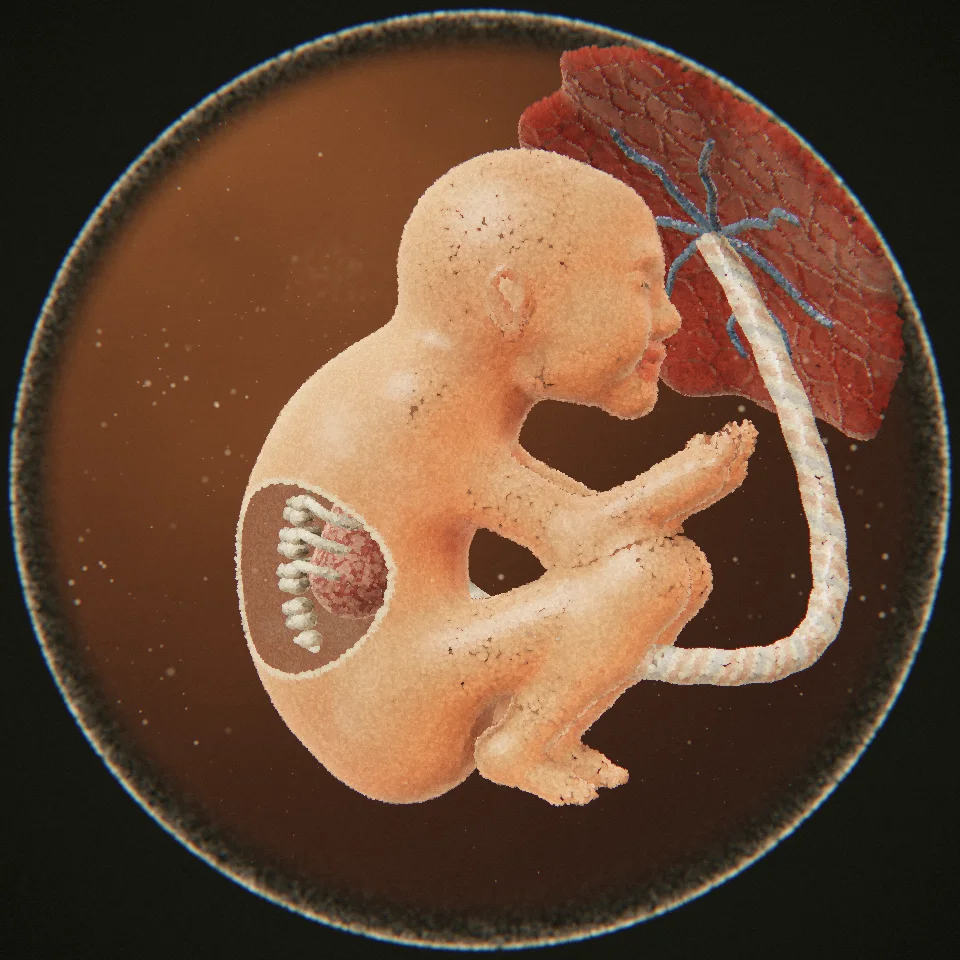
Your baby is about 41.1 cm from head to heel, roughly the size and weight of a coconut1. The WHO median estimated fetal weight for this week is 1,707 g2.
Your baby is very active, moving around, sucking their fingers and doing the odd somersault. Day by day they’re getting plumper and less wrinkled1. Lanugo begins to disappear3.
The amount of amniotic fluid is increasing, because your baby can now pee. They’re also practising sucking, a vital skill for feeding1.
Your baby is starting to recognise voices from outside the womb, so encourage your partner and any other children to talk to your bump1.
Your body
Your baby and your bump are still growing. In a couple of weeks you’ll both go through a final growth spurt, and your baby still has lots of fattening up to do1.
You’re nearly there. You’re very unlikely to go beyond another 9 or 10 weeks, and if your baby arrived in 6 weeks it wouldn’t be considered early1.
You may feel your bump tighten for 20 to 30 seconds and then relax, without hurting. These are Braxton Hicks contractions, or practice contractions, and they’re normal1.
Backache, heartburn, cramps, constipation, swollen hands and feet and sleeping problems are still common1.
Health and tips
Your baby’s position. If this is your first baby, your midwife or doctor will probably measure your womb, from the top of your pubic bone to the top of your bump. They’ll also gently feel your belly to work out which way up your baby is lying. Some babies are already head down, ready for birth, and you may have noticed your bump shift downwards1.
If your baby is head up, there’s still time for them to turn, and some don’t move down into the pelvis until labour starts. If they stay bottom first (breech), that could affect the type of birth you can have. If the position is awkward or the placenta is blocking the way, a caesarean may be recommended. You can talk through the risks and benefits before you decide1.
Breast or bottle. It’s a good time to think about how you’d like to feed your baby. Breast milk contains antibodies that help fight infections, makes stomach bugs and breathing problems less likely, and is there whenever your baby needs it1.
But not everyone is able to breastfeed, for example because of medication that could pass into breast milk or recovery from surgery. Formula and lots of cuddles can still give your baby a great start1.
Where your baby will sleep. For the first few months you’ll need a crib, carry cot or Moses basket. If you’re borrowing a cot, ideally get a new mattress. It should fit snugly with no gaps and be clean and waterproof1.
Don’t use pillows or duvets, which can cause overheating or suffocation. Use a baby sleeping bag or layers of light blankets instead1.
Slings and carriers. If you’re thinking of buying one, make sure you know how to use it safely1.
Vaccines. The NHS advises having the whooping cough vaccine before week 33. The RSV vaccine can be given right up until labour. If you haven’t had them yet, talk to your midwife1.
For your partner or supporter
If you’re her partner or the person supporting her, talk to the baby through the bump. Your baby is starting to recognise voices, and it helps build a bond1.
In the final weeks it also helps to be ready4:
- Make sure you can be reached at all times.
- Decide how you’ll get to the hospital, if that’s where the birth will be.
- If you’re driving, check the car works and has fuel, and do a trial run to see how long it takes.
- Pack a bag for yourself too, with snacks and your phone.
Planning a week or so off work after the birth also helps, especially if you don’t have family nearby4.
When to get help
If the contractions become painful or start coming at regular intervals, it could be a sign of early labour, so contact your midwife or doctor1.
If you notice your baby’s movements change or stop, contact your midwife or hospital5. Get medical advice about any vaginal bleeding1.
Get urgent help if you have a severe headache that doesn’t go away with painkillers, vision problems, pain below your ribs, or sudden swelling of your face, hands or feet6.
Frequently asked questions
How big is the fetus at week 31 of pregnancy?
According to the NHS, it is about 41.1 cm, head to heel. The WHO median estimated weight is 1,707 g.
Can a baby's cot have pillows?
No, because pillows can cause overheating or suffocation.
What are Braxton Hicks contractions?
They're practice contractions: your bump tightens for 20 to 30 seconds and then relaxes, without hurting. If they're painful or regular, get advice.
Sources
- National Health Service (NHS), Regne Unit. 31 weeks pregnant guide. NHS Best Start in Life.
- World Health Organization (Kiserud T, et al.). The World Health Organization Fetal Growth Charts: A Multinational Longitudinal Study of Ultrasound Biometric Measurements and Estimated Fetal Weight. PLoS Med 2017;14(1):e1002220.
- American College of Obstetricians and Gynecologists (ACOG). How Your Fetus Grows During Pregnancy (FAQ156). Darrera revisió: març de 2026.
- NHS 111 Wales. Dads and partners. 111.wales.nhs.uk.
- National Health Service (NHS), Regne Unit. 29 weeks pregnant guide. NHS Best Start in Life.
- National Health Service (NHS), Regne Unit. Pre-eclampsia. nhs.uk.
- Hospital Clínic de Barcelona. Pregnancy and Childbirth: alarm signs. clinicbarcelona.org.