Everything here is written from scientific sources. If you have any doubts, check the original sources.
Your baby this week
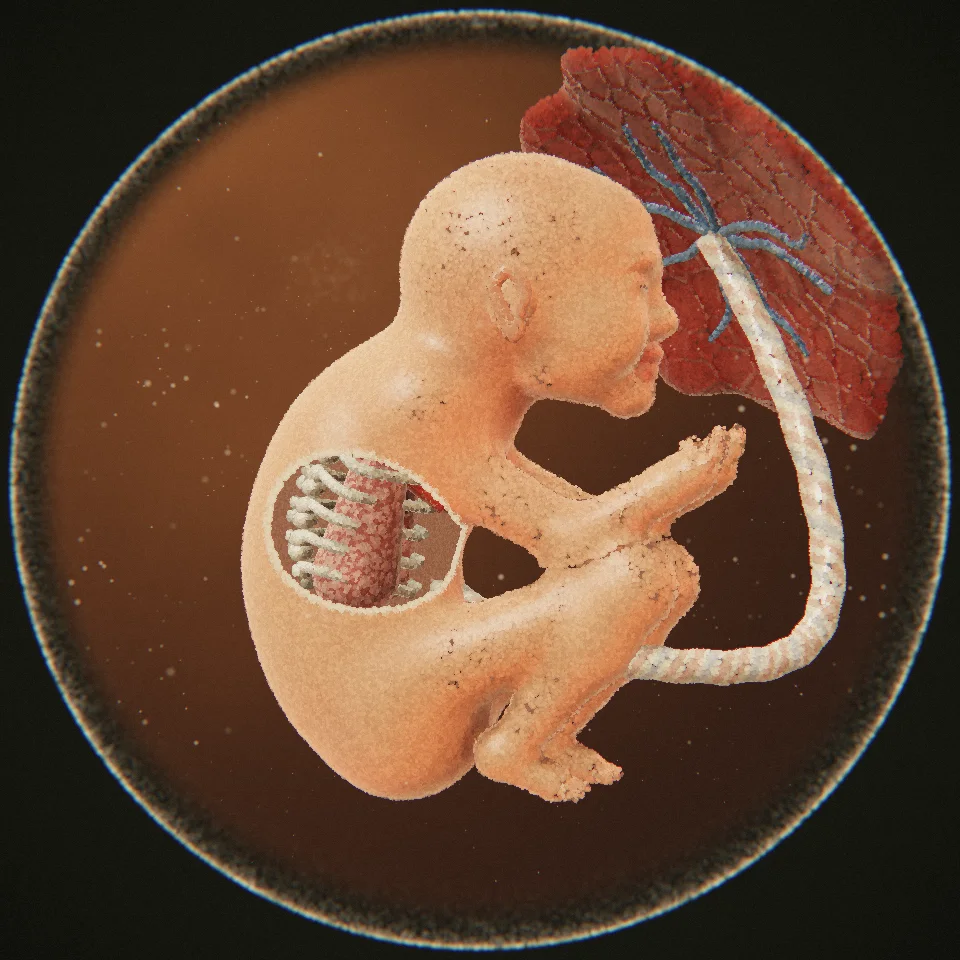
Your baby is about 37.6 cm from head to heel, roughly the size of an aubergine1. The WHO median estimated fetal weight for this week is 1,189 g2.
Their heart rate changes throughout pregnancy. Around week 5 or 6, when it can first be detected, it’s about 110 beats per minute, and it rises to about 170 in weeks 9 and 10. Now it has slowed to around 140, and it will be about 130 at birth1.
That’s still much faster than yours, which will be around 80 to 85 beats a minute. Partly that’s because such a small heart can’t pump much blood at once, so it makes up for it by beating faster. It also helps keep your baby warm1.
The lungs begin making surfactant3.
Your body
Welcome to the third and final trimester. Over the next few weeks you’ll probably feel more uncomfortable and tired1.
You may get heartburn and indigestion, from the pressure of your growing baby and the effect of hormones on your digestion. Your back is under strain from the extra weight, and your joints and ligaments are looser than usual1.
Your ankles, feet and face may puff up a little, especially when it’s hot. This is probably water retention, but get it checked in case it’s pre-eclampsia, which can push your blood pressure up very quickly even if you feel well1.
Nosebleeds can start now too, because of hormonal changes, sometimes even while you sleep1. Rest helps with a lot of these symptoms, so get as much as you can1.
Health and tips
Week 28 tests. NICE recommends a blood test at 28 weeks and anti-D for rhesus-negative women who are not sensitised4. Ask which tests your clinic offers.
RSV vaccine. Respiratory syncytial virus can cause bronchiolitis in young babies, a lung infection that makes it hard for them to breathe and feed. The NHS recommends the vaccine at around week 28, though it can be given later, right up until labour. It reduces the risk of severe bronchiolitis by 70% in your baby’s first 6 months, because your immunity passes to them through the placenta1.
Three ways to avoid infections. The NHS recommends1:
- Washing your hands with soap and water for at least 20 seconds, especially around children or nappies, which can carry cytomegalovirus (CMV).
- If you have a cat, wearing gloves to empty the litter tray or asking someone else to do it, as cat poo can carry the bug that causes toxoplasmosis. Wear gloves for gardening too.
- If you haven’t had chickenpox, telling your midwife if you’ve been in contact with someone who has it.
If you get a nosebleed. Sit or stand up rather than lying down. Pinch your nose just above the nostrils for 10 to 15 minutes, lean forward and breathe through your mouth. An ice pack on the top of your nose also helps1.
Eating. There’s no need to eat for two. In the third trimester you may need around 200 extra calories a day, which isn’t much: roughly two slices of wholemeal toast. A varied diet with plenty of fruit and veg is enough1.
Where your baby will sleep. It’s a good time to sort this out, before your energy starts to run low. Your baby will spend a lot of time in a cot, so make sure it’s safe1.
For your partner or supporter
At this stage, tiredness and irritability often come back, and the baby can feel very heavy. If you’re her partner or the person supporting her, now is the time to share the housework if you don’t already. Doing the shopping yourself is a real help, because carrying puts a lot of strain on her back5.
If you smoke, cigarette smoke is dangerous for babies. Get help to stop and, in the meantime, don’t smoke near her5.
Decide together where the baby will sleep and check that the cot is safe1.
When to get help
If your face, hands or feet are swelling, tell your midwife1. Get urgent help if the swelling is sudden or comes with a severe headache, vision problems, pain below your ribs or vomiting6.
Itching in pregnancy is usually harmless, but get urgent help if it’s very intense, if it’s mainly on the palms of your hands or soles of your feet, or if it’s worse at night. It could be intrahepatic cholestasis of pregnancy, a liver condition that needs treatment7.
Get medical advice about any vaginal bleeding1.
Frequently asked questions
How big is the fetus at week 28 of pregnancy?
According to the NHS, it is about 37.6 cm, head to heel. The WHO median estimated weight is 1,189 g.
What should I do about a nosebleed in pregnancy?
Sit or stand, pinch your nose for 10 to 15 minutes and lean forward.
Do I need to eat more in the third trimester?
A little. The NHS says you may need about 200 extra calories a day, roughly two slices of wholemeal toast.
Sources
- National Health Service (NHS), Regne Unit. 28 weeks pregnant guide. NHS Best Start in Life.
- World Health Organization (Kiserud T, et al.). The World Health Organization Fetal Growth Charts: A Multinational Longitudinal Study of Ultrasound Biometric Measurements and Estimated Fetal Weight. PLoS Med 2017;14(1):e1002220.
- American College of Obstetricians and Gynecologists (ACOG). How Your Fetus Grows During Pregnancy (FAQ156). Darrera revisió: març de 2026.
- National Institute for Health and Care Excellence (NICE). Antenatal care (NG201): Recommendations. Guia, 19 d’agost de 2021.
- NHS 111 Wales. Dads and partners. 111.wales.nhs.uk.
- National Health Service (NHS), Regne Unit. Pre-eclampsia. nhs.uk.
- National Health Service (NHS), Regne Unit. Itching and intrahepatic cholestasis of pregnancy. nhs.uk.
- Hospital Clínic de Barcelona. Pregnancy and Childbirth: alarm signs. clinicbarcelona.org.