Everything here is written from scientific sources. If you have any doubts, check the original sources.
Your baby this week
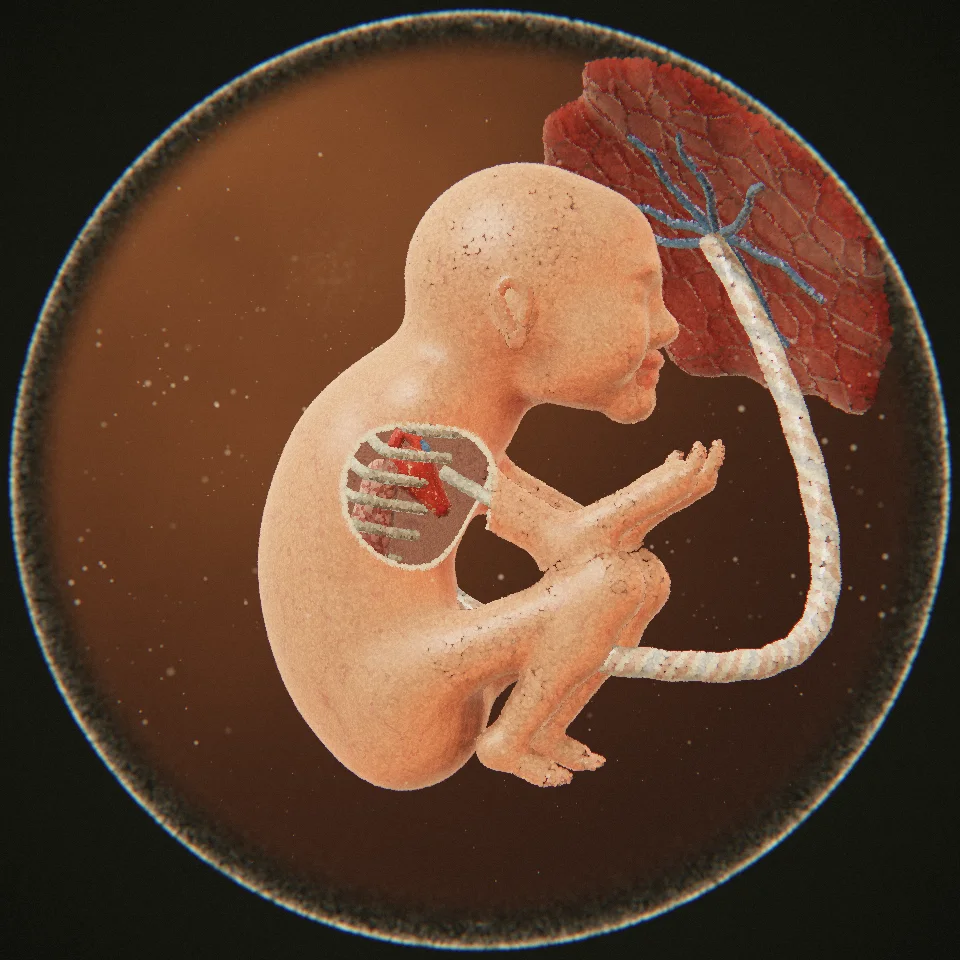
You are now halfway through your pregnancy. The fetus is about 25.6 cm long, roughly the size of a banana. From now on babies are measured from head to heel; before this they are measured from head to bottom, because the legs are curled up and hard to see1.
Your baby is now covered in a white, greasy layer called vernix. It is thought to protect their skin from drying out in the amniotic fluid, and it also helps them make their way down the birth canal1.
They are getting more active every day. As well as kicking, punching and turning, your baby may be sucking their thumb, which develops the sucking reflex they will need to feed. You may feel this as bubbling or fluttering in your tummy1.
Fetal growth. The WHO charts describe estimated fetal weight week by week2. A percentile shows where a measurement sits within the reference population, and a single value is not a diagnosis.
| Week | 10th percentile | Median | 90th percentile |
|---|---|---|---|
| 20 | 286 g | 330 g | 380 g |
| 28 | 1,026 g | 1,189 g | 1,368 g |
| 40 | 3,084 g | 3,617 g | 4,135 g |
You can see the full curve in the week-by-week guide.
Your body
You might be woken at night by sudden sharp pains in your calves. It is probably cramp, which is common in pregnancy and caused by muscle spasms. Rub the muscle hard or pull your toes up towards your ankle. Being more active during the day may help you avoid it1.
Other common symptoms at this stage include1:
- Tiredness and trouble sleeping.
- Pain on the sides of your bump as your womb grows.
- Constipation, indigestion and heartburn.
- Dizziness and swollen hands and feet.
The anatomy scan
When it is done. The ISUOG guideline recommends offering this scan to all pregnant women. It places it at about 18 to 24 weeks, depending on technical considerations and local legislation3. The BCNatal protocol does it between weeks 20 and 22, preferably at week 214. The exact date will depend on your hospital.
What is checked. According to the BCNatal protocol, this scan assesses4:
- The placenta, the umbilical cord insertion and the amniotic fluid.
- Fetal growth.
- Fetal anatomy.
What it can and cannot detect. In expert hands, most clinically important structural anomalies can be detected, but detection varies widely between centres and operators3. A normal scan does not guarantee that the baby will be born without any condition4.
If the scan cannot be completed, it should be repeated or you should be referred to another examiner3.
What comes next. The BCNatal protocol, last updated in 2016, includes a third-trimester scan at week 37±1 in low-risk pregnancies. Where there is a high risk of growth restriction, serial checks are done at weeks 28±1, 32±1 and 37±14. Each hospital may follow a different schedule.
Health and tips
Whooping cough vaccine. Whooping cough is on the rise, and having the vaccine in pregnancy protects your baby. In the UK it is usually offered around week 20, but you can have it from week 16 to week 32. The immunity you build up passes to your baby through the placenta and protects them until their first vaccine at 8 weeks old1. The schedule varies by country: in the US it is given between weeks 27 and 365. Ask which one applies to you.
Movements from now on. From week 24 you should notice your baby moving every day. To check, Hospital Clínic advises lying on your left side after a main meal and counting at least 10 movements over two hours6.
Eating and staying active. You don’t need extra calories until the third trimester, which starts at week 28. A varied diet with plenty of fruit and vegetables is enough. The recommendation is 150 minutes of exercise a week; listen to your body1.
For your partner or supporter
If you are her partner or the person supporting her, try to be there on the day of the scan and see the baby on the screen. If extra tests are needed, your support is especially important7.
Look into antenatal classes for couples: the more you know about labour, the more you can help. And if she is anxious, encourage her to talk to her midwife, to you or to family and friends. It may take a while for her to open up, so be patient7.
If you’re expecting twins
With twins, an anomaly scan is also offered at 20 weeks to check that the babies are developing normally. Between 16 and 20 weeks you should be offered a cervical length scan, which helps assess the risk of premature birth. If your cervix is short, you may be offered progesterone tablets to take daily until 34 weeks8.
If your twins share a placenta but have separate sacs, you will have more scans, because they have a higher risk of twin-to-twin transfusion syndrome. If each twin has their own placenta, you will usually be scanned every 4 weeks. The risk of anaemia and pre-eclampsia is also higher, so go to every appointment8.
When to get help
Pre-eclampsia is most likely from 20 weeks onwards, although it can happen at any point. That is why your blood pressure and urine are checked at your appointments9.
Get urgent medical help, or call your midwife or maternity unit, if you have9:
- A severe headache that does not go away with simple painkillers.
- Vision problems, such as blurred vision or flashing lights.
- Pain below the ribs.
- Sudden swelling of the face, hands or feet.
- Heartburn that does not settle with antacids, vomiting, or feeling very unwell.
Get advice about any bleeding. Go to the emergency department if it is heavy, if you have severe tummy or shoulder pain, or if you feel dizzy or faint10.
Frequently asked questions
When is the anatomy scan done?
ISUOG places it at about 18 to 24 weeks. In the BCNatal protocol it is done between weeks 20 and 22, preferably at week 21.
How much does the fetus weigh at week 20?
The WHO median is 330 grams, with a range of 286 to 380 grams between the 10th and 90th percentiles.
What can I do about leg cramps?
Rub the muscle hard or pull your toes up towards your ankle. Being more active during the day may also help prevent them.
Sources
- National Health Service (NHS), Regne Unit. 20 weeks pregnant guide. NHS Best Start in Life.
- World Health Organization (Kiserud T, et al.). The World Health Organization Fetal Growth Charts: A Multinational Longitudinal Study of Ultrasound Biometric Measurements and Estimated Fetal Weight. PLoS Med 2017;14(1):e1002220.
- International Society of Ultrasound in Obstetrics and Gynecology (ISUOG). ISUOG Practice Guidelines (updated): performance of the routine mid-trimester fetal ultrasound scan. Ultrasound Obstet Gynecol 2022;59(6):840-856.
- BCNatal: Hospital Clínic, Hospital Sant Joan de Déu, Universitat de Barcelona. Protocolo: screening ecográfico fetal (actualització: 18 d’octubre de 2016). Protocols de Medicina Fetal i Perinatal.
- Centers for Disease Control and Prevention (CDC). Tdap vaccination during pregnancy. cdc.gov.
- Hospital Clínic de Barcelona. Pregnancy and Childbirth: alarm signs. clinicbarcelona.org.
- NHS 111 Wales. Dads and partners. 111.wales.nhs.uk.
- National Health Service (NHS), Regne Unit. Antenatal care with twins. nhs.uk.
- National Health Service (NHS), Regne Unit. Pre-eclampsia. nhs.uk.
- National Health Service (NHS), Regne Unit. Vaginal bleeding in pregnancy. nhs.uk.