Everything here is written from scientific sources. If you have any doubts, check the original sources.
Your baby this week
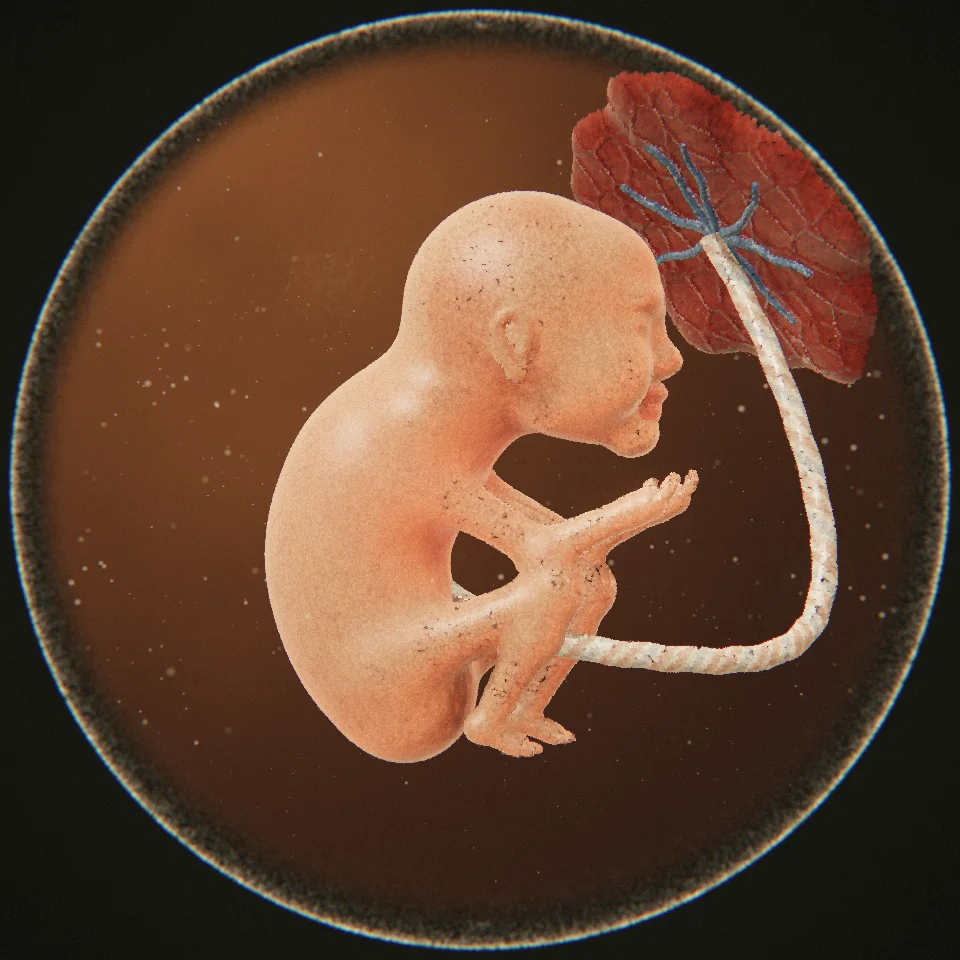
It is about 41 mm long from head to bottom, roughly the size of a fig. The head is still very large, but the body is growing quickly1.
The fingers and toes are separating, and there are tiny fingernails and miniature ears. Although your baby is kicking around inside your womb, you probably won’t feel anything for several weeks1. Around this stage the kidneys start making urine and the pancreas insulin2.
Until now your baby has been fed by a yolk sac, but a new organ, the placenta, is about to take over. It will nourish the baby and remove waste1.
Your body
There are only 2 weeks to go until your second trimester, when many women regain their energy as their hormones settle down1.
As your bump starts to show, your muscles and ligaments stretch, which can cause pains around your stomach1.
Your body is pumping up to 50% more blood than usual. This blood feeds your womb, but it can also make you feel hot, sweaty and dizzy: that’s a sign to rest. While the placenta takes over, the hormones involved can make you feel tired and emotional1.
Other common symptoms include nausea, mood swings, indigestion and heartburn, headaches, sore breasts, greasier skin and bloating1.
Your first scan
Hospitals in England usually offer 2 ultrasound scans during pregnancy, and the first is the dating scan, between 8 and 14 weeks. An ultrasound uses harmless invisible waves to build a picture of the inside of your womb1.
It can include a nuchal translucency measurement of the fluid at the back of the baby’s neck, as part of Down’s syndrome screening1.
The exact programme depends on your health system. In Catalonia, screening is offered to all pregnant women3. First-trimester screening there combines two markers in the mother’s blood, free beta-hCG and PAPP-A, with the nuchal translucency measured on the scan3.
The window for the first-trimester scan opens, between weeks 11 and 13+6 in the BCNatal protocol4. See the week 12 guide.
Health and tips
Tests. Around now you’ll be offered blood and urine tests and a blood pressure check. They’re a chance to check on your health and your baby’s1.
Tiredness. It can be intense, but gentle exercise such as walking may help you feel better1. If you’re new to exercise, you can start with 10 minutes a day and build up gradually5.
Vitamins and habits. Keep taking 400 micrograms of folic acid a day until at least week 12. There’s no need to eat for 2: a varied, balanced diet is enough. Try to stop smoking and drinking alcohol, and go easy on caffeine1.
Antenatal classes. Ask your midwife about antenatal classes. They’re a chance to meet other people and prepare for parenthood1.
For your partner or supporter
If you are her partner or the person supporting her, try to be there for the scan and see your baby on the screen. If she needs extra tests, your support is especially important6.
If she’s worried, go with her to the appointment, or talk it through when she gets home. You could also look for antenatal classes for couples: the more you know about labour, the more you’ll be able to help6.
When to get help
If your tummy pain is severe, see your midwife or doctor as soon as possible1.
If you bleed, call your midwife or maternity unit straight away. Get urgent help if the bleeding is heavy, if you have severe tummy or shoulder pain, or if you feel dizzy or faint7.
If you’re feeling anxious or low, don’t keep it to yourself: talk to your midwife or doctor1.
Frequently asked questions
How big is the fetus at week 11 of pregnancy?
According to the NHS, it is about 41 mm, head to bottom.
What does nuchal translucency measure?
The fluid at the back of the baby's neck. It is part of Down's syndrome screening.
Why might I feel hot and dizzy at 11 weeks?
Your body is pumping up to 50% more blood than before pregnancy. It's a sign to rest.
Sources
- National Health Service (NHS), Regne Unit. 11 weeks pregnant guide. NHS Best Start in Life.
- American College of Obstetricians and Gynecologists (ACOG). How Your Fetus Grows During Pregnancy (FAQ156). Darrera revisió: març de 2026.
- Hospital Clínic de Barcelona, Centre de Diagnòstic Biomèdic. Programes de cribratge poblacional: cribratge prenatal. clinicbarcelona.org.
- BCNatal: Hospital Clínic, Hospital Sant Joan de Déu, Universitat de Barcelona. Protocolo: screening ecográfico fetal (actualització: 18 d’octubre de 2016). Protocols de Medicina Fetal i Perinatal.
- National Health Service (NHS), Regne Unit. Exercise in pregnancy. nhs.uk.
- NHS 111 Wales. Dads and partners. 111.wales.nhs.uk.
- National Health Service (NHS), Regne Unit. Vaginal bleeding in pregnancy. nhs.uk.
- Hospital Clínic de Barcelona. Pregnancy and Childbirth: alarm signs. clinicbarcelona.org.