Everything here is written from scientific sources. If you have any doubts, check the original sources.
Your baby this week
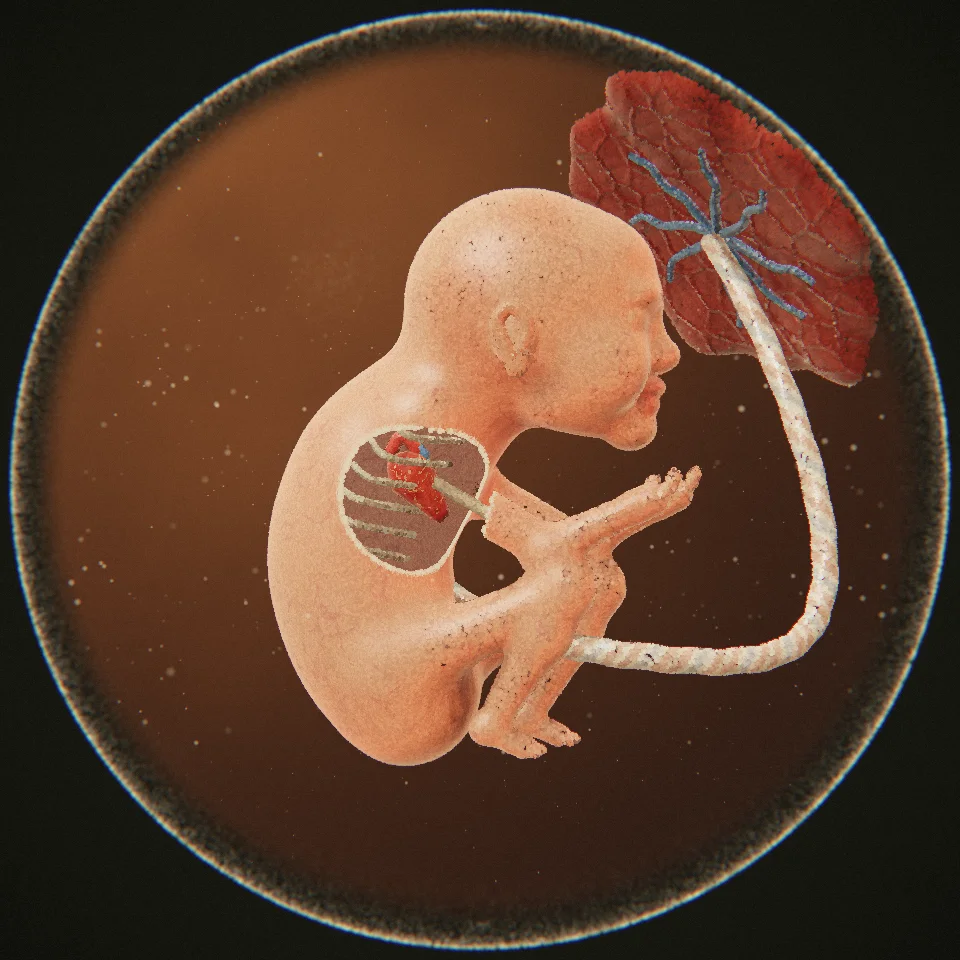
Your baby is about 5.4 cm from head to bottom, roughly the size of a plum. The internal organs and muscles have grown, the heartbeat can be picked up on an ultrasound scan and the skeleton is hardening into bone. The sex organs have formed, but most scans can’t tell the sex yet1.
Weeks are counted from the first day of your last period. Counted this way, pregnancy lasts about 40 weeks, or about 38 from fertilisation2. At week 12, about 10 weeks have passed since fertilisation. For an IVF pregnancy, the date is worked out from the age of the embryo and the day of transfer3. You can use the due date calculator.
Your body
The placenta has probably taken over feeding your baby, and your hormones may calm down a little. Your waist is likely thickening and your breasts getting bigger, and as the sickness eases you may feel hungrier. How big your bump looks depends on your hormones, your weight before pregnancy, how many babies you’ve had and the strength of your muscles1.
The first-trimester scan
The BCNatal protocol, from Hospital Clínic and Hospital Sant Joan de Déu in Barcelona, places this scan between weeks 11 and 13+6, preferably at week 124. The international ISUOG guideline covers the examination between 11+0 and 14+0 weeks5.
According to this protocol, the scan is used to4:
- Confirm that the pregnancy is inside the uterus and progressing.
- Find the number of fetuses and, if there is more than one, the chorionicity.
- Date the pregnancy.
- Measure the markers for aneuploidy.
- Make an early assessment of the anatomy.
- Measure the uterine arteries to calculate the risk of pre-eclampsia.
A first-trimester ultrasound is the most accurate way to establish or confirm gestational age3. While the crown-rump length is under 84 mm, the protocol dates the pregnancy from this measurement4.
Screening and cell-free DNA testing
In Catalonia, the prenatal screening programme is offered to all pregnant women and looks for trisomies 21, 18 and 136. First-trimester screening combines two markers in the mother’s blood, free β-hCG and PAPP-A, with the nuchal translucency measured by ultrasound6. The thresholds below are from this programme and may differ elsewhere.
| Calculated risk | What is offered |
|---|---|
| Between 1/10 and 1/250 | Cell-free DNA test or invasive diagnostic test |
| 1/9 or higher | Invasive diagnostic test |
If you arrive after week 14, the programme offers second-trimester screening, using blood markers only6.
The cell-free DNA test on the mother’s blood can be done from week 10. Despite its accuracy, it is still a screening test: a high-risk result must be confirmed with an invasive diagnostic test6. ACOG recommends offering both screening and diagnostic tests, and notes that you have the right to accept or decline them after counselling7.
Health and tips
Weight. Most women put on between 10 and 12.5 kg, mostly after week 20. You don’t need to eat more for the baby: only in the third trimester do you add about 200 calories a day1.
Folic acid. The NHS advises 400 micrograms a day until at least week 121. The US Preventive Services Task Force recommends 0.4 to 0.8 mg a day, from at least one month before conception through the first 2 to 3 months of pregnancy8. The Harvard School of Public Health puts folate needs during pregnancy at 600 mcg DFE a day9. Follow the advice your team has given you.
Work. Many women tell their employer after week 12, once the risk of miscarriage falls. You can ask for a risk assessment of your workplace1.
For your partner or supporter
If you are the partner or the person supporting her, try to be there for the scan. If extra tests are needed, your support matters even more. You may also be asked for a blood test, to check whether the baby is at risk of an inherited condition such as thalassaemia or cystic fibrosis10.
If you’re expecting twins
The scan between 11 and 14 weeks is especially important. It is the best time to find out whether the twins share a placenta and membranes, known as chorionicity, and to check your dates. The nuchal translucency test can be done at the same time11.
If they share a placenta but have separate sacs, you can expect more scans, because they have the highest risk of twin-twin transfusion syndrome. If each has their own placenta, the risks are much lower and you’ll usually be scanned every 4 weeks11.
When to get help
If you feel anxious or low, talk to your midwife or doctor1.
Always get any bleeding checked. Get urgent help if it is heavy, if you have severe tummy or shoulder pain, or if you feel dizzy or faint12.
Frequently asked questions
When is the first-trimester scan done?
In the BCNatal protocol, between weeks 11 and 13+6, preferably at week 12.
Does a high-risk result mean the fetus has a trisomy?
No. Screening estimates a risk. A high-risk result must be confirmed with an invasive diagnostic test.
I'm hungrier now. Do I need to eat for two?
No. A varied, balanced diet is enough. According to the NHS, you only need about 200 extra calories a day from the third trimester.
Sources
- National Health Service (NHS), Regne Unit. 12 weeks pregnant guide. NHS Best Start in Life.
- Hospital Clínic de Barcelona. Pregnancy and Childbirth. clinicbarcelona.org.
- American College of Obstetricians and Gynecologists (ACOG). Committee Opinion No 700: Methods for Estimating the Due Date (reafirmada el 2025). Obstet Gynecol 2017;129(5):e150-e154.
- BCNatal: Hospital Clínic, Hospital Sant Joan de Déu, Universitat de Barcelona. Protocolo: screening ecográfico fetal (actualització: 18 d’octubre de 2016). Protocols de Medicina Fetal i Perinatal.
- International Society of Ultrasound in Obstetrics and Gynecology (ISUOG). ISUOG Practice Guidelines (updated): performance of 11-14-week ultrasound scan. Ultrasound Obstet Gynecol 2023;61(1):127-143.
- Hospital Clínic de Barcelona, Centre de Diagnòstic Biomèdic. Programes de cribratge poblacional: cribratge prenatal. clinicbarcelona.org.
- ACOG; Society for Maternal-Fetal Medicine. Screening for Fetal Chromosomal Abnormalities: ACOG Practice Bulletin, Number 226. Obstet Gynecol 2020;136(4):e48-e69.
- US Preventive Services Task Force. Folic Acid Supplementation to Prevent Neural Tube Defects: Preventive Medication. Recomanació, 1 d’agost de 2023.
- Harvard T.H. Chan School of Public Health. Folate (Folic Acid): Vitamin B9. The Nutrition Source.
- NHS 111 Wales. Dads and partners. 111.wales.nhs.uk.
- National Health Service (NHS), Regne Unit. Antenatal care with twins. nhs.uk.
- National Health Service (NHS), Regne Unit. Vaginal bleeding in pregnancy. nhs.uk.
- Hospital Clínic de Barcelona. Pregnancy and Childbirth: alarm signs. clinicbarcelona.org.